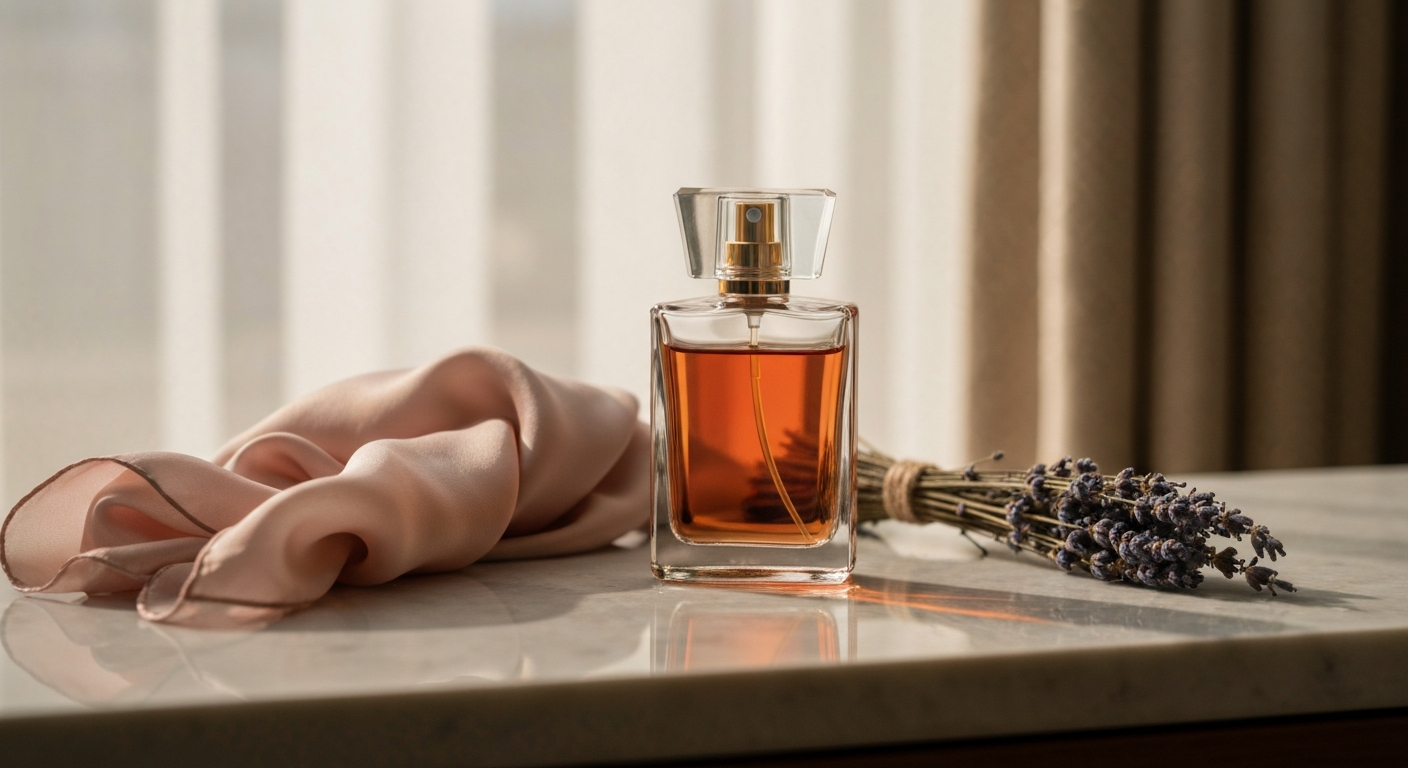
Pheromone perfume is a chemistry product first and a scent product second. Both halves respond to timing. Spray it at the wrong moment, on the wrong skin, in the wrong amount, and even a well-made bottle does nothing interesting. So here's the practical timing guide the brand sites never bother to write.
The 20-minute rule
Apply pheromone perfume about twenty minutes before you want it working. That window lets the alcohol carrier flash off. It also lets the warm base settle into your skin and start radiating at body temperature. The base is whatever the formula leans on: amber, musk, a copulin blend.
Spray and walk out the door in the same minute, and you smell like solvent for ten minutes. Then a loud top note takes over for ten more. Only after that does the scent read the way it was designed to. So by the time you arrive, the least flattering phase went to your Uber driver.
Pre-game it. Spray before you do your makeup, or right after you get dressed. Then finish getting ready while it settles.
Pulse points for women's perfumes
Pulse points are spots where blood vessels run close to the skin. That keeps the area slightly warmer and helps the fragrance diffuse. For women's pheromone perfumes, the working set is:
- Sides of the neck, just under the jaw
- Inner wrists (one spray, then press wrists together gently, no rubbing)
- Behind the ears
- Center of the chest, just below the collarbone
- The décolletage, which is often more exposed in women's outfits than in men's and projects scent upward as you move
The décolletage advantage
The décolletage is the real asymmetric advantage in women's application. A scoop or v-neck creates a warm channel. That channel pushes scent up toward your own face and toward anyone you lean into. One light spray there, undisturbed by fabric, often beats three sprays buried under a turtleneck.
Skip the wrist-rubbing
The old advice to rub your wrists together after spraying is wrong. Rubbing bruises the top notes and shortens longevity. Press, don't rub.
Apply to clean skin, not over moisturizer or oil-based lotion
This is where most women lose half their perfume without realizing it. Heavily scented lotions sit as a barrier film on the skin. So do cocoa butter, coconut oil, and anything labeled "nourishing" or "rich." Spray pheromone perfume onto that film and the molecules bind to the lotion, not your skin. You get weaker diffusion and a muddled scent.
The fix is simple. Apply to truly clean skin, post-shower and before any product. Or use a fragrance-free, water-based moisturizer on the spots you plan to spray. Slightly hydrated skin actually holds scent longer than dry skin. It just has to be hydrated with something neutral.
Want to layer with a body product? Do it on purpose. Apply an unscented body oil first, then the perfume on top. There's more on stacking in pheromone perfume layering tips .
Quantity matters more than you think
Two to four sprays total, across the pulse points above. That's it. Pheromone perfumes are usually denser than mainstream fragrances. The active molecules need to register at close range. The supporting scent runs warmer too: musks, amber, copulin accords instead of a typical floral or fresh.
Eight sprays of a copulin-heavy perfume in an office reads as desperate. That's the trap the hype sets: overapplication is the fastest way to repel people. A molecule that smells subtly skin-warm at two sprays smells like a locker room at six. The chemosignal works at close range, in trace amounts. If you can still smell yourself strongly after thirty minutes, you used too much.
Oil-based roll-ons need even less. Pure Instinct's roller, for example: one swipe on each wrist, one on the neck, done. Oils don't flash off the way alcohol sprays do. What you apply is what you wear for hours.
The cycle-phase question
This is the one section that genuinely differs from the men's version of this guide. It deserves an honest answer. Some women's pheromone brands tell you to apply more during the follicular and ovulatory phases. Their logic: that's when men respond most to women biologically.
The biology underneath that pitch is real. Copulins are the short-chain aliphatic acids found in vaginal secretions. They do shift in concentration across the menstrual cycle, peaking around ovulation. Cutler's 1998 axillary extract work and Verhaeghe's 2013 review both sit in this broader literature on cycle-linked chemosignaling. So the "this is when men respond most" claim is anchored in real reproductive biology, not invented from scratch.
The open question is the leap to "so you should time your bottled perfume to your cycle." No study yet shows that applied copulin perfumes need cycle-matched dosing to work. Your body's natural chemosignal is produced continuously and modulated by hormones. A sprayed external scent layered on skin is a different system. Wyatt's 2015 paper in Proc R Soc B cautions that the field has often reasoned past its data on exactly this kind of inference. The effect is real; the cycle-matching is the part still waiting on evidence.
Practical take: if you already cycle-track, treat the follicular and ovulatory window as your "lean in" days for a copulin-heavy perfume. It's harmless and probably additive. You may feel more sociable and forward in that window anyway, and the perfume reinforces it. If you don't track, don't start tracking just for this. The bottle works either way.
One more thing worth noting. Hormonal birth control flattens the natural cycle. It also flattens whatever cycle-linked variation in your chemistry might exist. If you're on hormonal contraception, the cycle-phase question is basically moot for you.
Specific use cases
Date night
Three sprays: neck, décolletage, one wrist. Apply twenty minutes before he picks you up. Pick a formula with copulins or warm musk over anything sharp or aldehydic at close range. Close-contact wear should be soft and skin-like. Pure Instinct's roller and copulin-forward boutique perfumes both work well. See the best pheromone perfumes for women for genre picks.
Office and professional settings
Two sprays, both low. One wrist, one inside the elbow or behind the knee. Keep the projection close. Office is not the venue for a copulin bomb. Choose a cleaner formula, or layer the pheromone underneath a recognizable mainstream scent. Athena Pheromones for women is designed for exactly this kind of low-projection professional wear.
Daytime, casual
Two sprays, wrists and behind one ear. Light enough to wear in a yoga class or coffee shop without anyone noticing. Present enough that someone who hugs you registers it.
Special event (wedding, party, anywhere you're sweating)
Three to four sprays, plus one swipe of unscented oil-based moisturizer on the chest first. The oil extends longevity through a long evening of dancing or heat. Bring the bottle for a single reapplication around hour five.
Reapplication
Most alcohol-based pheromone perfumes need a top-up around the four to six hour mark. Oil-based and copulin-heavy formulas last longer. Copulin molecules bind to skin proteins and persist. For full longevity details and the chemistry behind drydown, see how long does pheromone perfume last .
When you reapply, one or two sprays maximum on the same pulse points. You're refreshing a base that's still there. You're not starting from zero.
What NOT to do
- Don't spray onto clothing, especially silk, wool, or anything dry-clean only. Pheromone molecules and copulin accords bind to fabric. They linger as a stale, faintly sour note long after the wear you'd rather forget.
- Don't spray into your hair. Hair plus pheromone perfume is a high-projection cloud you can't control or scale back once it's there.
- Don't stack two different pheromone perfumes on the same day. The molecules compete and the scent turns muddy. Pick one bottle per outing.
- Don't apply over heavily scented body lotion, sunscreen, or self-tanner. The base scent of those products fights the perfume.
- Don't expect a single application to last twelve hours. It won't, whatever the brand promises.
- Don't use an androstadienone product as your women's pheromone perfume. That's a male-target molecule. If a women's perfume lists it, the brand is confused. Look for copulin-based or estratetraenol-based formulas instead.
FAQ
Can I apply pheromone perfume right after a shower?
Yes, and it's one of the best times. Skin is clean, slightly warm, and lightly hydrated. Pat dry first. Spraying onto wet skin dilutes the product.
Should I apply more in summer or winter?
Slightly less in summer, slightly more in winter. Heat amplifies projection, and dry winter air mutes it. The number of sprays barely changes. The perceived strength does.
Does it matter which wrist I spray?
No. Body chemistry is symmetric enough that left versus right changes nothing you'll notice.
Can I apply pheromone perfume on my period?
Yes. The cycle-phase timing is about peak-response windows, not about avoidance. Nothing about menstruation interacts with topical perfume application.
Is one good bottle better than three okay ones?
Yes, every time. A well-made $35 bottle of Pure Instinct or RawChemistry , used correctly, beats a drawer of cheap ones used carelessly.
Honest summary: timing and skin prep account for most of the gap between a perfume that fell flat for someone and one that quietly pulls compliments. The bottle is necessary, but it's not sufficient. Twenty minutes ahead, clean skin, three sprays, the right pulse points. That's the whole technique.
We may earn a commission if you buy through our links. The routine above costs nothing, and it works on whatever bottle is already on your dresser.
No comments yet